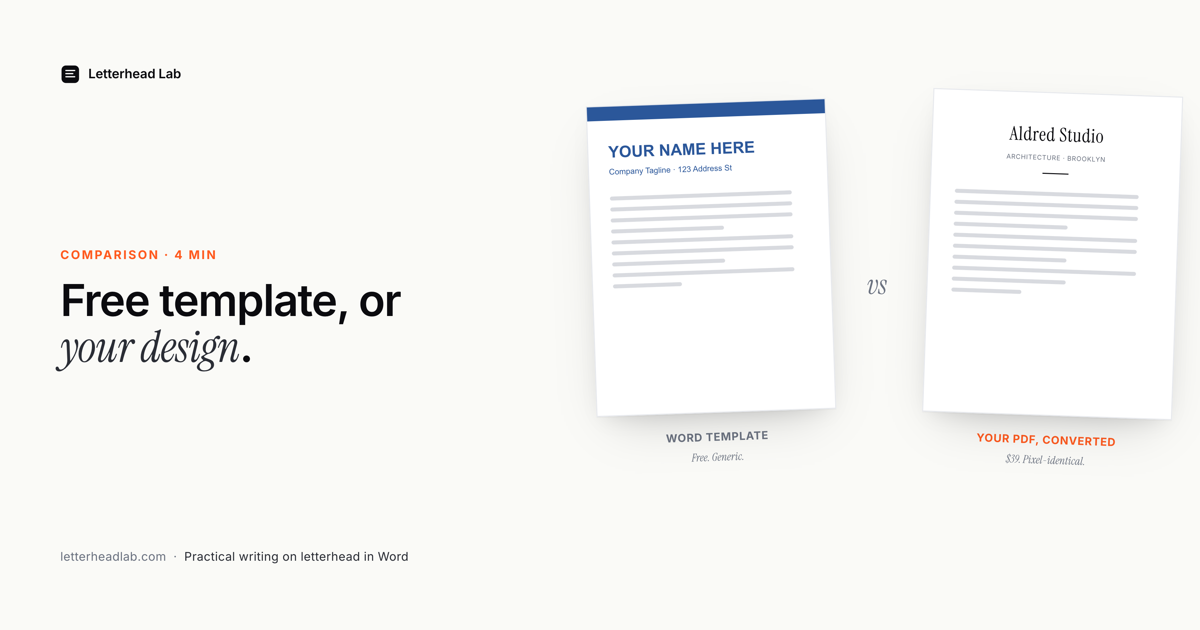
If you searched for "Word letterhead template," you probably landed on Microsoft's gallery first. It has a couple of dozen free templates, downloadable in one click. They look fine. They're free. So what's the case for paying for the converted version of your own?
1. The template is generic. You're not.
The Microsoft templates were designed to look reasonable for everyone. That's their whole job — not to stand out. The Bauhaus letterhead. The geometric letterhead. The "business" letterhead with a blue gradient bar.
If you're a sole practitioner sending an introductory email, that's probably fine. If you're:
- A law firm where letterhead is part of the gravitas
- A family office writing under a monogram
- A founder closing a deal where presentation matters
- A designer who already commissioned a real identity
…a free template undercuts what you spent on the brand.
This is the reason most people who land on a Microsoft template close the tab and go back to Google. They wanted "my letterhead in Word," not "a letterhead in Word."
2. Templates are for new identities. You already have one.
Free templates make sense if you're building from scratch — you have no logo, no typography, no brand color, and you need something workable in 5 minutes. That's a real audience.
If you already paid a designer between $500 and $5,000 for a real identity, the math is different. You don't need a template; you need a way to use the identity you already own.
The PDF your designer sent is the canonical version. It has the right typography, the right kerning, the right colors, the foil position, the embossed monogram. Replacing it with a template means throwing all that work away. The better move is to turn that PDF into a reusable Word template — your design, in the format Word wants.
3. Editing the template back to your design is harder than converting
The most common "workaround" we see: someone downloads a Microsoft template, then tries to edit it to match their actual brand. Replace the placeholder logo. Change the font. Adjust the colors. Move the address block.
This takes longer than people expect. The fonts in Microsoft templates are usually not the fonts you have licensed. The placeholder logo is locked into a specific position. The color theme has to be edited globally. By the time you're done, you've spent two hours and the result still looks like a Microsoft template wearing your colors.
Compare to: drop your designer's PDF into Letterhead Lab, drag two sliders, download. Sixty seconds.
A note on file format. A .docx is a document; a .dotx is a true template that opens a fresh untitled copy each time, so the master can't be overwritten. If several people share one letterhead, the .dotx template format is the safer choice. It comes with the Multi-page bundle.
When the template path is genuinely the right move
To be fair: there's a real audience the templates are right for. If you:
- Don't have a designed letterhead and aren't going to commission one
- Send maybe two formal letters a year
- Run a business where the letterhead doesn't carry brand weight — internal IT memos, HR forms
…just use Microsoft's template gallery. It's free, it works, you don't need us. Save your $19.
The decision tree
- Do you have a designed PDF letterhead? If no → Microsoft templates or Etsy. If yes → keep going.
- Do you need to send letters that match the rest of your brand? If no → templates are fine. If yes → convert your PDF.
- Comfortable spending 45 minutes in Acrobat and Word doing it by hand? If yes → here's the manual workflow. If no → convert it automatically.
What about the other paid options?
You'll see Etsy listings selling editable Word letterhead templates for $5–$30. They're prettier than the free Microsoft ones, but they have the same fundamental problem: they're someone else's design. If you already own a letterhead, you don't need a different one.
You'll also see services like Canva and 99designs that will design a letterhead from scratch. Different problem. Letterhead Lab is for people who already had the design done and just need it in Word — which is exactly the gap a design agency closes for its clients when it ships the Word file alongside the brand package.
Frequently asked questions
- Is a free Word letterhead template good enough?
For low-stakes, occasional letters with no brand to protect, yes. If your letterhead is part of how your firm or family is perceived, a generic template undercuts the design you already paid for.
- What's the difference between a .docx and a .dotx letterhead?
A
.docxis an ordinary document; opening it edits that file. A.dotxis a template — Word opens a new untitled copy from it, so the master is never overwritten. For a shared letterhead, the.dotxis the safer format.- Can I just edit a Microsoft template to look like my brand?
You can try, but it usually takes longer than converting your own PDF, and the result still reads as a template. Converting the designed PDF keeps your real typography and layout intact.