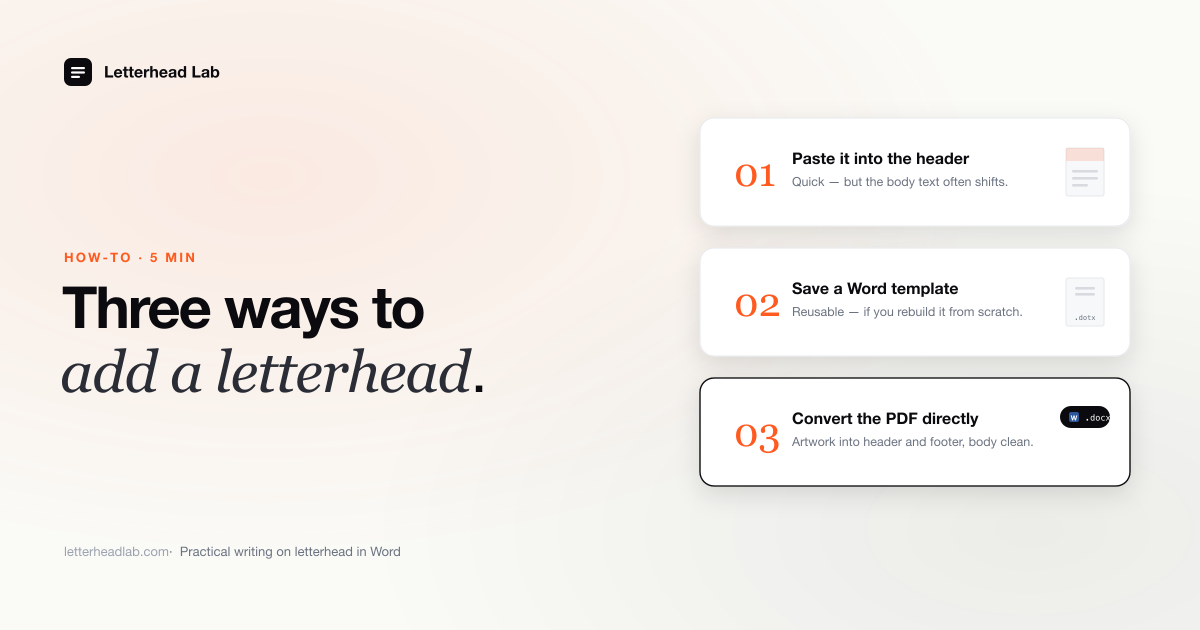
"Add a letterhead to Word" sounds like one task, but it splits into three depending on what you start with: a flat image, nothing at all, or a designed PDF. Each starting point has a method that fits and two that fight you. Here is all three, and an honest read on which to pick.
Method 1 — Insert a letterhead image into the header
This is the right method when you already hold a flat image of the letterhead — a PNG or JPG that a designer exported, or one you saved yourself. You are placing a finished picture, not arranging type. The whole job is getting it into Word's header, not the body.
The header is the layer that repeats on every page and stays clear of the text you type. Put the letterhead in the body and it shifts the moment you press Enter; put it in the header and it stays anchored.
- Insert → Header → Blank to open the header area.
- With the cursor in the header, Insert → Pictures → This Device, and choose your letterhead image.
- Click the image, open Layout Options (or right-click → Wrap Text), and set it to Behind Text, anchored to the page. Your letter text then sits on top of the artwork instead of being pushed around by it.
- Size it to the page — full page width if the art bleeds edge to edge, text-area width if it sits inside the margins. Drag from a corner handle so the proportions hold.
- Set the body's top margin so the first line clears the artwork. A 1.5" header wants a top margin of at least 1.75".
- Right-click the image → Edit Alt Text and describe it briefly — "Acme LLP letterhead" is enough. Alt text travels with the file and keeps the document accessible if it is ever sent to a court system.
The catch: this only works cleanly when you genuinely have a flat image. The full step-by-step, including extracting artwork when all you have is a PDF, is in our guide to inserting a PDF into a Word header.
When this fits: you have a PNG or JPG of the finished letterhead and want it in one document.
Method 2 — Start from a Word template
This method fits the person with no designed letterhead who is not going to commission one. You open a pre-structured starting point — header height, margins, and footer already set — and fill in your name, address, and logo by hand.
Word ships letterhead templates in File → New, and more sit in the online gallery. They are arranged, not designed: Word cannot kern type, set tracking, or reproduce foil or engraving. For internal memos and low-stakes mail that trade is reasonable. For correspondence carrying brand weight, it is not.
A blank template gallery still leaves you arranging everything yourself. A pre-built skeleton with the structure already correct is faster. That is what the letterhead-to-Word template tool gives you — the header height, margins, and footer built right, so you only drop in your details. Save the result as a .dotx template if a team will draft from it, so nobody saves a letter over the master.
When this fits: you have no design and no PDF, and the letterhead is for internal or low-stakes use.
Method 3 — Convert a designed PDF letterhead
This is the method for the person who already owns a real, designed letterhead — a PDF from a designer or a stationer — and wants that exact design working in Word. You do not want to rebuild it; you want the file you already paid for to function as a letter page.
The instinct is to run the PDF through a generic PDF-to-Word converter. Do not. A generic converter assumes you want every element editable, so it picks the design apart — the logo is rebuilt in a font Word guesses at, the address block splinters into overlapping frames, and any foil detail is lost.
A correct conversion does the opposite. The artwork goes into Word's header and footer untouched, at full resolution, and only the body is left editable — the same model as Method 1, done automatically. You upload the PDF to Letterhead Lab's PDF-to-Word converter, set the crop in a live preview, and download the Word file in about a minute. Your PDF stays in your browser the whole time — the conversion runs client-side, so a file carrying a confidential client name is never uploaded. Pricing is concrete: Single is $19 per page, and the Multi-page bundle is $49 flat for up to 10 pages. If your letterhead is already laid out and you just need it dropped into a Word document, the add-letterhead-to-Word tool handles that path directly.
When this fits: you have a finished designed PDF and need that exact design, pixel-for-pixel, in Word.
Which method to use
Start from what you have in hand. With a flat image, insert it into the header — Method 1. With nothing designed, start from a template — Method 2. With a designed PDF, convert it — Method 3.
Do not rebuild a designed PDF from scratch and do not run it through a generic converter — both produce something worse than what you started with. The longer walkthrough of every path, with a full decision tree, is in letterhead in Word — every way to do it. Most law firms we work with land on Method 3, because they already paid for the design and the job is to convert it, not redo it.
Frequently asked questions
- How do I add a letterhead to a Word document?
It depends on what you have. With a flat image, insert it into Word's header set to Behind Text. With no design, start from a template. With a designed PDF, convert it so the artwork is preserved in the header and footer and only the body stays editable.
- Why shouldn't I use a generic PDF-to-Word converter for a letterhead?
A generic converter tries to make every element editable, so it rebuilds the logo in the wrong font and splinters the address into overlapping text boxes. A letterhead conversion keeps the artwork as artwork — placed in the header and footer untouched — and leaves only the body editable.
- Will the letterhead repeat on page two?
Only if it sits in Word's header rather than the body. Anything in the header repeats on every page automatically; anything pasted into the body does not, and shifts when the text reflows.